Practicing alone does not have to mean repeating the same serve against a wall. The right table tennis robot can deliver consistent feeds, varied spins, and structured drills so you can build technique at your own pace.
These 10 options cover compact trainers, machines with collection nets, and advanced models with remote or app control. Use the guide below to match features, capacity, and training flexibility to your goals.
Best 10 Table Tennis Robots for Solo Training Picks for 2026
Feature-Rich Pick
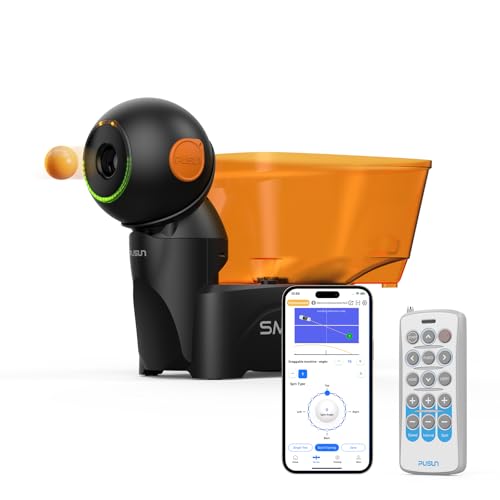
- 200+ pre-saved training drills
- Triple-motor spin, speed, and landing control
- Remote and app control
Best For: Structured solo practice with extensive customization
Simple Classic

- Topspin and underspin adjustment
- 12–70 balls per minute
- 110-ball capacity
Best For: Straightforward repetitive stroke practice
Ball-Recycling Value

- Adjustable spin, speed, and swing speed
- Capture net recycles returned balls
- Includes 100 standard balls
Best For: Low-interruption spin and footwork practice
Portable Beginner Pick
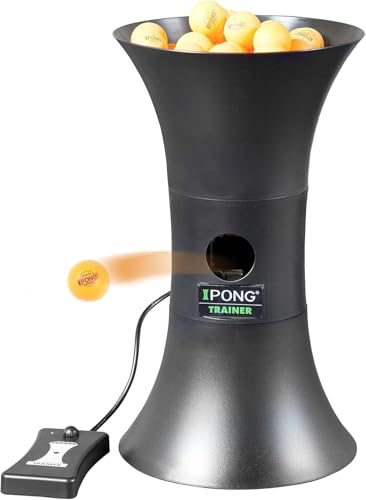
- Battery-operated wireless design
- Adjustable speed via wired remote
- 80 ABS training balls included
Best For: Simple, portable beginner practice
Most Programmable
PONGBOT 576-Trajectory Table Tennis Robot

- 576 pre-saved trajectories
- Remote and app control
- Adjustable speed, spin, landing, and height
Best For: Customizable solo practice and structured drills
Best Simple Setup
iPong V300 Solo Training Robot

- Wireless remote control
- 30–70 balls per minute
- No app download required
Best For: Accessible practice for beginners and families
Best Value Setup
PONGBOT NOVA S Pro Training Robot

- Includes ball-recycling net
- 264 preset drills
- Remote, app, and custom-drill support
Best For: Convenient multi-level practice with varied drills
Adjustable Practice Pick
Custom Spin Table Tennis Robot

- Adjustable spin, speed, frequency, landing, and height
- Hopper holds approximately 120 standard 40 mm balls
- Single-player design for partner-free practice
Best For: Players seeking customizable solo drills
Complete Training System

- Recycling net holds up to 200 balls
- 8.9–76 mph speed range with extensive spin controls
- Ambidextrous control and included 100 balls
Best For: Players wanting a full solo practice system
Compact Spin Trainer

- Creates 36 different spinning-ball combinations
- Compact design with easy installation
- Requires at least 15 standard 40 mm balls
Best For: Portable, varied spin practice
Feature-Rich Pick – Dora Smart Pro
The Dora Smart Pro is designed for players who want table tennis robots for solo training with extensive drill variety. Its triple-motor system supports adjustments for spin, speed, frequency, and ball placement, while the remote and app controls provide convenient ways to start preset or customized sessions.
Best For: Players seeking programmable drills and broad table coverage for structured solo practice.
Pros:
- Includes more than 200 pre-saved training drills.
- Triple-motor design adjusts spin, speed, and landing position.
- Supports random serves, variable frequency, and customized drills.
- Includes a remote control and power adapter.
Cons:
- The feature-rich controls may be more than beginners need.
- The supplied details list conflicting warranty durations.
The Dora Smart Pro stands out when training variety and precise ball placement matter most. It is a strong option for users prepared to spend time tailoring drills to specific receiving and footwork goals.
Simple Classic – iPong Original Trainer
The iPong Original is a straightforward choice for table tennis robots for solo training. It holds up to 110 balls and lets players adjust topspin, underspin, and serving frequency, making it suitable for repeating fundamental strokes without needing a practice partner.
Best For: Players who want an uncomplicated robot with adjustable spin and feed rate.
Pros:
- Adjustable topspin and underspin settings.
- Feed frequency ranges from 12 to 70 balls per minute.
- Holds up to 110 balls.
- Assembles in under a minute and includes a remote.
Cons:
- The supplied features do not mention app control or preset drills.
- It is designed around 40mm and 40-plus balls.
This model favors ease of setup over advanced programming. Its adjustable spin and feed rate make it a practical entry point for repeatable solo sessions and basic technique work.
Ball-Recycling Value – Automatic Trainer with Net
This automatic trainer combines adjustable serving variables with a capture net, making it a practical option among table tennis robots for solo training. Players can adjust ball spin, ball speed, and swing speed separately, while the net helps collect returned balls for continued practice.
Best For: Players who value ball recycling and varied spin practice with included balls.
Pros:
- Separately adjustable spin, ball speed, and swing speed.
- Offers 36 different spinning-ball combinations according to the supplied notes.
- Includes a capture net to recycle balls.
- Comes with 100 ping-pong balls.
Cons:
- Requires more than 15 standard 40mm balls to operate.
- The supplied details do not mention a remote or app.
- Its plastic construction weighs about 5 kg.
The capture net can reduce the interruption of collecting balls between drills. Before buying, confirm that you have enough international-standard 40mm balls, since the machine will not serve with fewer than 15.
Portable Beginner Pick – iPong Trainer
The iPong Trainer is a compact, battery-operated option for table tennis robots for solo training. Its wired remote adjusts speed, and its wireless placement, quick assembly, and included 80 ABS balls make it convenient for beginners who want to practice without an outlet or app.
Best For: Beginners and mobile users who prioritize simple setup and portable practice.
Pros:
- Battery-operated and wireless for flexible placement.
- Wired remote provides adjustable speed.
- Includes 80 40mm ABS training balls.
- Assembles by twisting the feeder onto the shooter.
Cons:
- The supplied notes mention speed adjustment but not spin or frequency controls.
- Battery operation requires managing batteries rather than using an outlet.
- It does not include app control or programmed drills.
With its compact 19-by-11-inch footprint and simple operation, the iPong Trainer is easy to store and move. It is best suited to foundational practice rather than highly customized training routines.
Most Programmable – PONGBOT 576-Trajectory Table Tennis Robot
For players comparing table tennis robots for solo training, this PONGBOT model stands out for its extensive drill programming. It offers 576 pre-saved trajectories, remote and app control, automatic oscillation, and adjustments for frequency, speed, rotation, landing, and height.
Best For: Adult players who want highly customizable solo practice sessions and a broad selection of preset trajectories.
Pros:
- Includes 576 pre-saved trajectories.
- Supports both remote and app control.
- Allows adjustment of frequency, ball speed, rotation, landing, and height.
- Automatic oscillation helps vary ball placement.
Cons:
- At 14 kg, it is relatively heavy compared with lighter training robots.
- The listed dimensions may require dedicated storage space.
Choose this model if programming depth matters more than portability. Its wide range of trajectory and delivery adjustments makes it a strong fit for structured, varied training at home or in a club setting.
Best Simple Setup – iPong V300 Solo Training Robot
The iPong V300 is a straightforward option for shoppers seeking table tennis robots for solo training without app setup. Its wireless remote controls frequency, ball speed, direction, and spin, while the machine can deliver up to 70 balls per minute.
Best For: Beginners, families, and players who want quick setup with remote-controlled practice options.
Pros:
- Uses a wireless remote with a memory button.
- Adjusts frequency, ball speed, direction, topspin, and backspin.
- Delivers from 30 to 70 balls per minute.
- Designed for fast assembly without app downloads.
Cons:
- The supplied notes identify it as a solo, no-playback-mode model.
- Its listed dimensions are 19 by 10 by 11 inches, so table-side space is still needed.
This is a practical pick when ease of use is the priority. The remote and simple assembly make it accessible, while adjustable delivery settings provide enough variety for basic technique and repetition work.
Best Value Setup – PONGBOT NOVA S Pro Training Robot
For players looking for table tennis robots for solo training with easier ball collection, the PONGBOT NOVA S Pro includes a ball-recycling net. It also offers remote or smartphone-app control, 264 pre-programmed drills, and support for custom drills.
Best For: Players at different skill levels who want preset and custom practice routines with a supplied recycling net.
Pros:
- Includes a ball-recycling net to simplify setup.
- Offers both remote and smartphone-app control.
- Comes with 264 programmed drills.
- Supports custom drills and is intended for beginners through advanced players.
Cons:
- The supplied notes do not specify delivery speed, spin, or frequency ranges.
- Its plastic construction may feel less substantial than a metal-framed model.
The NOVA S Pro is compelling for buyers who value convenience and drill variety without needing the larger preset library of the higher-end PONGBOT model. The included net and dual-control options make repeated solo sessions easier to organize.
Adjustable Practice Pick – Custom Spin Table Tennis Robot
ZXMOTO Table Tennis Robot Automatic Ping Pong Robot Machine for Training (HP-07)
Check Price On AmazonFor players comparing table tennis robots for solo training, this compact HP-07 model focuses on adjustable practice settings. You can customize spin, frequency, ball speed, landing, and height, while its hopper holds approximately 120 standard 40 mm balls.
Best For: Adult players who want customizable solo drills in a relatively compact robot.
Pros:
- Adjustable spin, frequency, speed, landing, and height
- Holds approximately 120 standard-size balls
- Designed for one-player training without a partner
Cons:
- Requires international-standard 40 mm balls
- Short one-month warranty listed
- Plastic construction may feel less substantial than heavier machines
This is a straightforward choice when drill customization matters more than premium construction or extended warranty coverage. Confirm that your practice setup uses the required 40 mm balls before ordering.
Complete Training System – WAYMARK JT-A Robot With Net
The WAYMARK JT-A stands out among table tennis robots for solo training by combining a serve machine with an automatic recycling net. It offers adjustable speed, angles, landing points, and multiple spin types, while the net system can hold up to 200 balls for longer sessions with less cleanup.
Best For: Beginners through advanced players who want a feature-rich solo setup with ball collection.
Pros:
- Automatic recycling net holds up to 200 balls and includes 100 balls
- Adjustable serving speed from 8.9 to 76 mph
- Supports topspin, backspin, no-spin, sidespin, mixed-spin, and nine spin modes
- Ambidextrous control placement and a two-year support/spare-parts availability claim
Cons:
- Fits tables up to 2.5 inches thick
- Larger net system requires more setup space than a standalone robot
- Heavier and more involved than compact practice machines
With its broad speed and spin range, recycling net, and customizable drills, the JT-A is the most complete option here for structured solo practice. Measure your table thickness and available floor space before buying.
Compact Spin Trainer – 36-Mode Ping Pong Robot
This compact ping pong robot is a practical entry in the table tennis robots for solo training category. It delivers 36 spinning-ball combinations, supports topspin and backspin with sidespin combinations, and uses a hopper holding approximately 110 balls.
Best For: Players who want a portable, easy-to-install robot for varied spin practice.
Pros:
- Offers 36 different spin-ball combinations
- Small, convenient design with easy installation
- Supports double-end or optional single serving
- Includes a one-year warranty for qualifying product issues
Cons:
- Requires at least 15 balls for operation
- 40 mm international-standard balls are required and balls are not included
- Landing point is not fixed
This model makes sense for shoppers prioritizing portability and spin variety over precise placement control. Keep at least 15 compatible balls loaded, and plan to purchase balls separately.
How We Picked the Best Table Tennis Robots for Solo Training
We focused on the features that matter most during individual practice: feed consistency, spin variety, speed and frequency adjustment, oscillation, drill programming, ball capacity, and ease of setup. We also considered whether each robot includes a collection net, remote control, app support, or training balls. Because product specifications and included accessories can vary by listing, confirm the current details before buying.
Quick Comparison
| Best For | Look For | Useful Advantage |
|---|---|---|
| Beginners | Simple controls and adjustable speed | Easy repetition without a steep learning curve |
| Structured practice | Preset drills and multiple spin settings | More purposeful sessions |
| Advanced players | Custom trajectories, oscillation, and app control | Greater precision and variety |
| Convenient cleanup | Integrated collection net | Less time spent retrieving balls |
| Compact spaces | Desktop design and modest footprint | Faster setup and easier storage |
Key Buying Factors for Table Tennis Robots for Solo Training
Spin, Speed, and Placement Control
A robot should challenge you without making every ball unreturnable. Look for independent or clearly adjustable controls for topspin, backspin, sidespin, speed, frequency, and placement. Oscillation is especially useful because it forces movement instead of letting you stand in one position.
Drills and Customization
Preset drills help beginners start quickly, while custom trajectories are more valuable for players working on footwork, third-ball attacks, or backhand-to-forehand transitions. App and remote controls can make adjustments easier, but simple onboard controls may be more reliable for straightforward sessions.
Ball Handling and Setup
Check the hopper capacity and whether the package includes regulation-size balls. A capture net can return balls automatically and reduce interruptions. Also measure your table and available practice area; some machines are designed for tabletop use, while larger net-equipped models need more room.
Noise, Durability, and Support
Motors and repeated ball impact create noise, so consider where you will train. Favor sturdy construction, accessible replacement parts, clear instructions, and a return policy that covers missing accessories or inconsistent performance.
Who Should Buy Which Table Tennis Robots for Solo Training?
Choose a basic iPong-style trainer if you want an affordable introduction to solo practice and mainly need repeatable feeds. A compact desktop model suits apartments, casual users, and players who value quick storage. If retrieving balls interrupts your rhythm, select a machine with a collection net. Players who follow structured programs should prioritize preset drills and several spin modes, while competitive or advanced users will benefit most from app control, custom drills, oscillation, and broader trajectory adjustment.
Before ordering, confirm ball compatibility, included quantities, control method, dimensions, and the latest feature list. The best table tennis robot is the one you can set up consistently and use often.